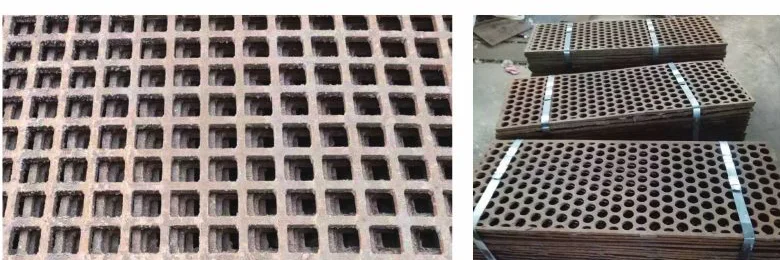
Choose a screen for your operating conditions
Start with the feed and impact conditions. High-manganese steel can work harden at the surface under sufficient repeated impact and deformation while retaining a tough core. Its suitability therefore depends on the duty: describe the largest feed particles, the way material reaches the deck and the wear pattern of the current panels. Low-impact fine screening should be reviewed separately rather than assuming that the same material will provide the same wear benefit.
Water-toughening is part of the specified preparation for these ZGMn13 cast panels. Confirm the material grade and heat-treatment requirement with the order, and discuss any inspection documents needed. The installation video shows the panel arrangement on equipment; it is not a hardness measurement or a service-life test.
Dimensions and specification checklist
Provide the panel outline, length, width and thickness; round, square or elongated opening shape and size; mounting-edge geometry; bolt-hole diameters and centre distances; and the deck support layout. A dimensioned drawing or old sample can be used to review a custom casting. Identify worn dimensions rather than treating them as original design measurements.
Where the deck uses individually bolted panels, the replacement scope can be reviewed panel by panel. Confirm access, supports and fastening details against the equipment documentation before ordering. Final casting geometry and mounting dimensions are agreed during drawing review.
Prepare your quotation request
- Identify the screen type, equipment model if known, and its position on the deck.
- Provide the aperture, overall dimensions and installation details, with photos or a drawing.
- Describe the material and wet or dry conditions, and tell us what you need to improve.
- Include quantity, delivery country and the required delivery window for quotation review.
Where you have a worn panel, identify measurements that are uncertain. We can review a drawing or sample before confirming the replacement specification, packaging and delivery arrangements.
Common questions
Are manganese cast screens the same as manganese woven screens?
No. A cast screen panel is formed as an integral casting. A woven screen uses intersecting wires, while a perforated plate has openings in steel plate. The construction, dimensions and mounting arrangement must all match the intended screening duty.
Why specify ZGMn13 and water-toughening treatment?
ZGMn13 is the high-manganese cast steel grade specified for this product. Water-toughening heat treatment is required before service. Record both the material grade and treatment requirement in the purchase specification and confirm the documentation you need.
When does the work-hardening characteristic help?
The benefit depends on sufficient impact and deformation at the working surface. Share the feed size, material, deck position and impact conditions so the application can be reviewed. A universal hardness or service-life multiplier cannot be assigned from the installation footage.
Can the opening pattern and mounting holes be customized?
Round, square and elongated openings, panel outlines, mounting edges and bolt-hole positions can be reviewed from a drawing or old sample. Confirm the final geometry and tolerances before production.
Can one damaged panel be replaced?
For a deck designed with individually bolted panels, a single-panel replacement can be considered after checking adjacent panels, supports and mounting dimensions. Send the deck drawing and photographs to confirm the replacement scope.
Related screening options